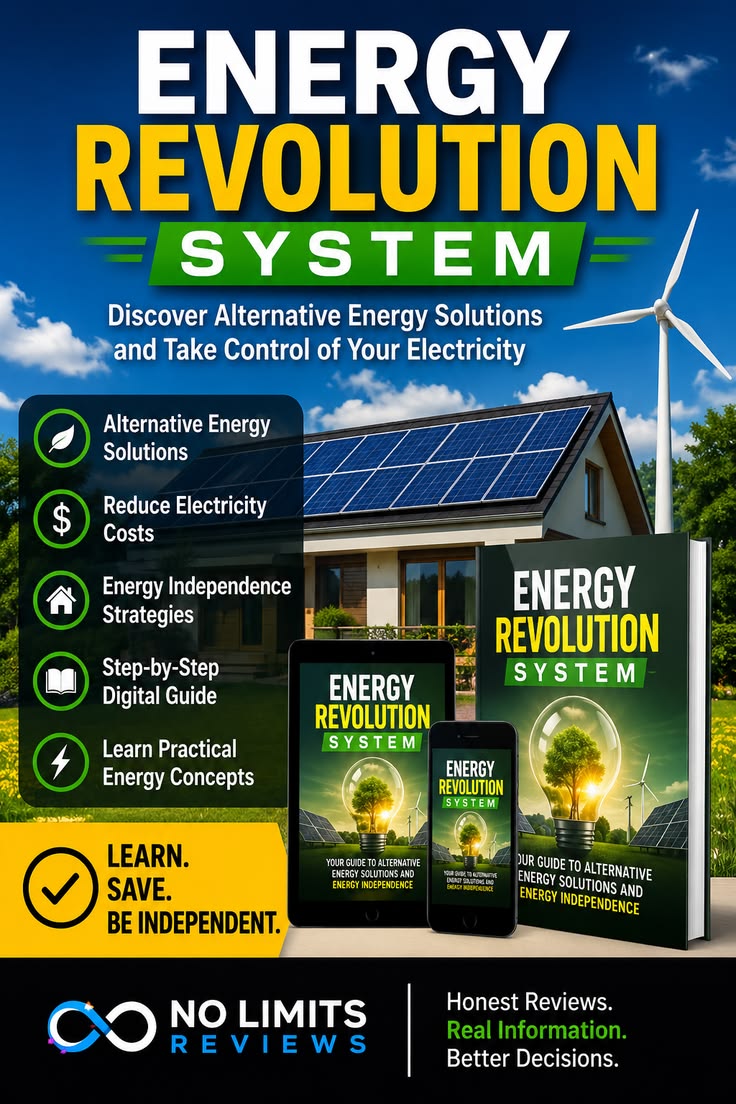
Energy Revolution System Review: 7 Powerful Insights for Cutting Power Costs
Energy Revolution System reviews explained: learn how the DIY guide works, what it claims, its limitations, value, and safer alternatives.
Click here – to Get 30% Off on the Energy Revolution Blueprint
Click here – to Learn More About Energy Saving System
Rising electricity prices and concerns about blackouts have made home energy independence an increasingly attractive idea. That helps explain the interest surrounding the Energy Revolution System, a digital DIY program marketed to people who want to learn how to build a small home energy device.
But understanding what you are actually buying is important.
The Energy Revolution System is not a conventional solar installation, portable power station, or ready-to-use home battery. Available product pages describe it as a digital blueprint and instructional program for building an electrical project using components such as coils and other electronic parts. Different sales pages make substantially different claims about how much electricity the resulting setup can produce or how much money it can save.
That distinction matters because a DIY educational project and a verified home-power system are very different things.
In this Energy Revolution System review, we'll examine what the product claims to teach, how the underlying electrical concepts relate to established technology, what independent evidence is available, whether the price represents reasonable value, and how it compares with a DIY battery-backup approach.
The goal isn't simply to say "buy" or "don't buy." It's to help you understand how the Energy Revolution System works in principle, what remains unverified, and which type of buyer it may—or may not—suit.
Why Trust This Information
This review is based on publicly available product information, technical references, independent commentary, and established information about electrical energy storage and generation.
We did not personally build or laboratory-test the Energy Revolution System, so this article does not claim first-hand performance results.
The evaluation focuses on:
What the seller says the system is
What the available documentation says it does
Whether its technical concepts correspond to established electrical principles
Whether independent performance evidence is available
Claimed pricing and refund terms
Ease of use
Safety considerations
Buyer suitability
Value compared with alternative approaches
This distinction is important for EEAT: a marketing claim should not automatically be treated as an independently verified result.
How We Evaluated
We looked at the Energy Revolution System using seven practical criteria:
1. Price and total cost
The advertised digital-guide price varies across sales pages. Several current pages advertise $39, sometimes compared with a stated regular price of $149.
However, the purchase price isn't necessarily the complete cost. A buyer also needs to consider components, tools, meters, batteries, wiring, connectors and potentially safety equipment.
2. Features
We considered whether the product provides useful instructional material, including diagrams, parts information and step-by-step guidance.
3. Technical plausibility
The system references coils, electromagnetic principles and Tesla-inspired designs. Tesla's 1894 patent US512340A does document a particular coil configuration and discusses self-induction and electrical apparatus.
That historical fact, however, does not establish that a modern DIY design can generate excess energy or eliminate household electricity bills.
4. Evidence
We looked for independent testing rather than relying solely on sales-page testimonials and promotional claims.
5. Safety
Any DIY electrical project deserves more scrutiny than a simple craft project. Incorrect wiring, unsuitable components or inappropriate connection to household circuits can create shock, fire or equipment-damage risks.
6. Practical value
A project can be interesting without being economically useful. We therefore separate educational value from energy-saving value.
7. Buyer suitability
The most important question is whether the product matches the buyer's actual objective.
What Is the Energy Revolution System?
The Energy Revolution System is presented as a digital DIY guide rather than a conventional physical generator.
Publicly available sales pages describe it as a collection of instructions and blueprints intended to help users construct a small electrical system themselves. Some versions specifically reference a bifilar or pancake-style coil and concepts associated with Nikola Tesla.
That is an important starting point.
You are generally not purchasing a finished generator that arrives ready to power your home.
Instead, the concept is closer to:
Obtain the instructions.
Source the required components.
Assemble the circuit or device.
Test its electrical output.
Learn how the system behaves under different conditions.
Some sales pages go considerably further, suggesting that the system can dramatically reduce electricity bills or produce substantial household power. Those claims should be treated as marketing claims unless supported by independent, reproducible measurements.
How Does the Energy Revolution System Work?
This is where many Energy Revolution System reviews become confusing.
At a basic level, coils and electromagnetic fields are completely legitimate areas of electrical engineering. Tesla's historical patent US512340A describes a specialized coil construction and discusses electrical characteristics including self-induction and capacitance.
However, a coil does not create energy from nothing.
A generator or energy-harvesting system needs an energy source. Depending on the design, that source might be:
Mechanical motion
Solar radiation
Chemical energy
Stored electrical energy
Thermal energy
Electromagnetic radiation
Another external energy source
A circuit can transform, store, transfer or regulate energy, but those functions should not be confused with creating unlimited energy.
Some Energy Revolution System marketing describes resonance or electromagnetic effects as allowing energy to be "captured," "amplified" or produced with minimal input. The exact claims vary considerably among websites.
That variation itself is a reason for caution.
What does "resonance" actually mean?
Electrical resonance is a real phenomenon. In an appropriately designed circuit, inductance and capacitance can interact at particular frequencies.
Resonance can improve the behavior of a circuit for a specific purpose. It doesn't repeal conservation of energy.
Therefore, if a product appears to promise more usable energy than the total energy supplied to the system, buyers should ask a simple question:
Where is the additional energy coming from?
That is a much better test than whether the sales page mentions Tesla, resonance or "free energy."
Energy Revolution System Review
Overview
The Energy Revolution System's strongest appeal is its DIY learning component.
For someone interested in electrical experimentation, coils, circuits and energy concepts, having a structured project can be more useful than randomly assembling components from internet tutorials.
The weakness is that the marketing surrounding the product can create expectations far beyond what a small DIY electrical project should reasonably be expected to deliver.
Key Features
Depending on the version or sales page, the program is promoted with features such as:
Digital blueprints
Step-by-step instructions
Materials or parts guidance
Video or visual instructions
DIY construction
Information about electrical efficiency
A money-back guarantee
Several current sales pages advertise a 60-day money-back guarantee, although buyers should verify the exact terms at checkout before purchasing.
Pros
Relatively low advertised entry price
Hands-on learning opportunity
Interesting introduction to electrical concepts
Doesn't require purchasing a finished generator
Potentially appealing to experienced DIY hobbyists
Can encourage readers to learn about energy efficiency
Cons
It is not a ready-to-use home power system
Component costs are separate
Independent performance testing is difficult to find
Marketing claims vary across websites
It should not be assumed to eliminate electricity bills
Electrical DIY work introduces genuine safety considerations
Specifications
Because the Energy Revolution System is a digital guide rather than a standardized manufactured electrical appliance, conventional specifications such as battery capacity, continuous wattage, surge wattage and certified efficiency do not appear to be consistently established.
That makes direct comparison with a commercial battery system difficult.
Who Should Buy It?
The product may make sense for:
Electrical hobbyists
DIY experimenters
Readers who want to understand basic electrical concepts
People interested in building rather than buying
Buyers who are comfortable treating the project as an experiment
Who Should Skip It?
Consider another solution if your main goal is:
Reliable emergency backup power
Running a refrigerator during an outage
Powering medical equipment
Running an air conditioner
Replacing grid electricity
Achieving predictable energy savings
Installing a system that can be professionally certified
Performance
This is the most difficult area to rate.
There are online testimonials and promotional claims describing substantial savings, but that is not the same as controlled, independent testing.
Some online reviewers have also questioned the product's claims, while other pages present it favorably.
Because the available evidence is inconsistent, assigning a high performance rating would be misleading.
Our assessment: interesting as an educational project, insufficiently verified as a major household energy source.
Pricing
Current sales pages commonly advertise the digital program for around $39, with some stating a higher regular price. Pricing can change, so readers should verify the live checkout price and refund conditions before purchasing.
The real project cost can be higher because components and tools may be additional.
Check current price: [Affiliate Link]
Alternatives
For buyers primarily interested in backup electricity, a properly designed battery system is a more straightforward option.
Energy storage is an established field: the U.S. Department of Energy identifies batteries and other storage technologies as important tools for improving grid flexibility, reliability and resilience.
Verdict: 3/5 as a DIY learning project; 2/5 as a substitute for dependable household power.
Energy Revolution System vs DIY Battery Backup
If your real goal is keeping essential appliances running during a power outage, the comparison becomes much clearer.
A DIY battery backup normally combines:
A battery
Battery-management protection
An inverter
Charging equipment
Appropriate fuses or circuit protection
Suitable cables and connectors
Optional solar charging
The battery stores energy that has already been generated elsewhere. The inverter then converts stored DC electricity into AC electricity for compatible loads.
This approach is fundamentally different from claims about generating electricity from ambient electromagnetic energy.
The Department of Energy describes energy storage as a way to shift energy over time and improve flexibility, stability, resilience and reliability.
For battery projects, safety and correct sizing matter. A battery system should never be treated as a casual wiring experiment, particularly when lithium batteries, high currents or household AC circuits are involved.
Energy Revolution System Pros and Cons
Advantages
Low initial cost: The advertised digital-guide price is relatively small compared with a complete home energy system.
Educational potential: The project can encourage users to understand coils, circuits and energy transfer.
DIY format: People who enjoy building things may prefer instructions over purchasing a finished device.
Potential refund protection: Current sales pages advertise a 60-day money-back guarantee. Verify the terms before buying.
Disadvantages
Evidence gap: There is not enough independent evidence to support treating the strongest electricity-saving claims as established fact.
Variable marketing: Different websites make different claims about the technology and expected results.
Additional costs: The advertised digital-product price doesn't necessarily represent the complete cost of building and testing a system.
Not a professional power installation: It should not be assumed to be suitable for direct connection to a home's electrical panel.
Buying Guide
1. Decide what problem you're solving
Before buying anything, decide whether you want:
A science project
Lower electricity consumption
Emergency backup
Off-grid capability
Solar energy storage
Whole-home resilience
These are different problems requiring different technologies.
2. Separate generation from storage
This distinction is frequently overlooked.
Generation creates electricity from an energy source.
Storage saves previously generated electricity for later use.
A battery is primarily a storage device. A solar panel is a generation device. A DIY coil experiment may demonstrate electrical behavior, but that doesn't automatically make it a practical household generator.
3. Look for measurable specifications
For a serious power system, look for:
Continuous output wattage
Peak/surge wattage
Battery capacity in Wh
Voltage
Inverter type
Charging time
Round-trip efficiency
Cycle life
Safety certifications
Warranty
Operating temperature
If a product makes major savings claims but doesn't provide independently verified measurements, be cautious.
4. Don't confuse low price with low total cost
A $39 digital guide may sound inexpensive. But if completing the project requires $100 or $200 in components and equipment, the meaningful comparison is the total project cost.
5. Avoid unrealistic expectations
Be especially cautious of claims suggesting that a small DIY device can effortlessly:
Power an entire home
Eliminate utility bills
Produce unlimited electricity
Work without a genuine energy input
Replace professionally engineered electrical infrastructure
The more extraordinary the claim, the stronger the evidence should be.
6. Consider your technical ability
A beginner may enjoy the educational material but still need help understanding:
Voltage
Current
Resistance
Power
AC vs DC
Electrical insulation
Overcurrent protection
Grounding
Never experiment with household mains electricity unless you understand the hazards and applicable electrical requirements.
Energy Revolution System Reviews and Consumer Reports
One of the most common searches is "Energy Revolution System reviews consumer reports."
This deserves a particularly careful answer.
We did not find evidence in the sources reviewed for this article establishing that Consumer Reports has independently tested and endorsed the Energy Revolution System.
A third-party page making the same query explicitly states that Consumer Reports has not officially reviewed or tested the product.
Therefore, claims such as "Consumer Reports approved" should not be repeated without a verifiable Consumer Reports source.
This is a good example of why readers should distinguish:
Consumer testimonials → third-party reviews → laboratory testing → independent certification
They are not equivalent forms of evidence.
Is the Energy Revolution System a Scam?
The answer isn't as simple as yes or no.
The product appears to exist as a digital DIY guide, and current sales pages describe what purchasers receive.
However, the more important question is whether the strongest marketing claims are supported by independent evidence.
Some websites describe dramatic electricity savings, while other reviews question whether those expectations are realistic.
There is also a website using the product's name that has received a very low automated trust score from ScamAdviser. That finding concerns the website/domain and should not automatically be treated as proof that the underlying digital guide itself is fraudulent.
Our practical conclusion:
Treat the Energy Revolution System as a DIY educational product, not as a scientifically verified "free electricity" solution.
That framing gives buyers a much more realistic basis for deciding whether the price is worthwhile.
Frequently Asked Questions
1. What is the Energy Revolution System?
It is marketed primarily as a digital DIY guide containing instructions and blueprints for building an electrical project at home rather than as a finished generator.
2. How does the Energy Revolution System work?
Sales materials reference coils, electromagnetic principles and resonance. The exact technical explanation varies between sales pages, so buyers should distinguish those marketing descriptions from independently verified performance.
3. Is the Energy Revolution System free energy?
There is no independent evidence establishing that it creates unlimited or "free" energy. A practical electrical system still requires an identifiable energy source.
4. Is Energy Revolution System a scam?
It is more accurate to describe it as a digital DIY product surrounded by aggressive and sometimes inconsistent marketing claims. Buyers should not assume the strongest savings claims are proven.
5. Has Consumer Reports reviewed it?
We found no reliable evidence that Consumer Reports has independently tested and endorsed the Energy Revolution System.

FocusFlow: The Last Timer You'll Need
Master the art of deep work with our analog-inspired digital interface. Zero tracking, 100% focus.
Learn more
Exploring the intersection of human psychology and digital culture. Documenting the shift toward slow media and helping readers find balance in an attention-based economy.
View all articles